

首页 - News & Events
News & Events/On September 10th, the launch ceremony for the English edition of A Study of Ancient Seal Inscriptions of Harappa and Mohenjo-daro — Origin of the Indus Script was held at the Embassy of Pakistan in China. H.E. Khalil Hashmi, Ambassador of Pakistan to China, and Professor Zhou Yushu, President of Inner Mongolia Honder College of Arts and Sciences, jointly unveiled the new book. Experts and scholars from cultural circles of China and Pakistan, journalists, as well as some staff members of the Embassy of Pakistan in China and Inner Mongolia Honder College of Arts and Sciences attended the launch event.
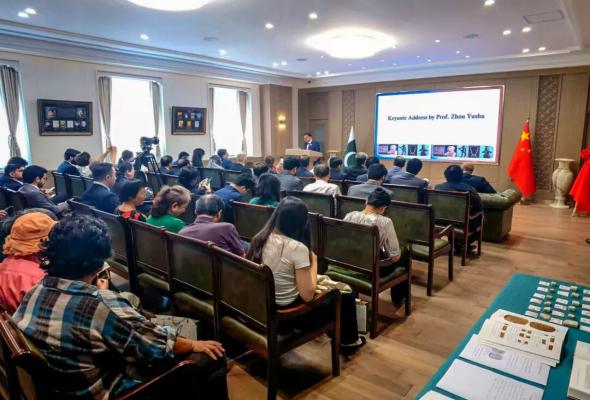
The Chinese edition of A Study of Ancient Seal Inscriptions of Harappa and Mohenjo-daro — Origin of the Indus Script was published by China Overseas Chinese Press in 2024. It is an achievement funded by the Social Science Fund of Inner Mongolia Autonomous Region. The publication and distribution of its English edition aims to present the research findings to the international academic community and offer references for more scholars studying the Indus Valley Civilization.

In his address, Ambassador Hashmi congratulated Professor Zhou Yushu and his research team on their outstanding academic achievements. He stated that the book systematically examines the seals and inscriptions unearthed from the ruins of Harappa and Mohenjo-daro and conducts comparative research with China’s prehistoric Hongshan Culture, opening up new perspectives for re-examining the ancient historical and cultural connections between China and Pakistan.
The ambassador remarked that this groundbreaking study not only raises innovative academic questions and pioneers new research approaches, but also represents a significant achievement in bilateral academic cooperation and cultural exchanges between China and Pakistan.
Ambassador Hashmi specially highlighted that in recognition of Professor Zhou Yushu’s extraordinary contributions to strengthening China-Pakistan friendship, the Government of Pakistan has decided to confer upon him the high-level civilian award, the Sitara-i-Quaid-i-Azam (Star of Quaid-e-Azam).

In his speech, President Zhou Yushu introduced that the research team carried out a systematic study of 401 seals unearthed at the Harappa and Mohenjo-daro sites. The team has tentatively deciphered 132 individual characters, which are classified into ten major categories by theme, including ancestors, fertility, thunder gods, and totem worship. The study reveals that the seals contain not only traditional Chinese totem symbols such as the dragon, phoenix and black mythical bird, but also the names of ancient tribes including "Shang" and "Zhou". This indicates that prehistoric cultural exchanges existed between the Liaohe and Yellow River basins in China and the Indus River basin in Pakistan as early as five to six thousand years ago.
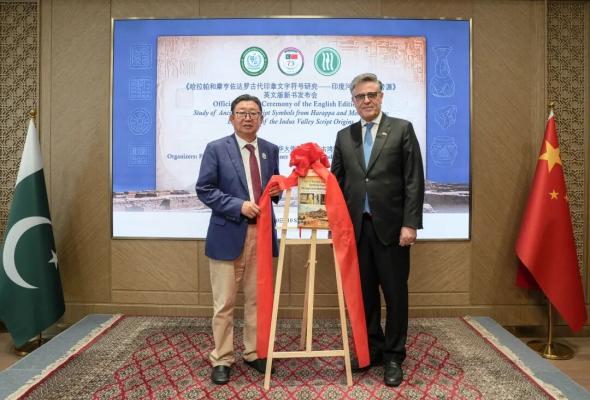
Ambassador Hashmi and President Zhou Yushu jointly unveiled the new English edition of the book.



Ambassador Hashmi and President Zhou Yushu took questions from journalists.
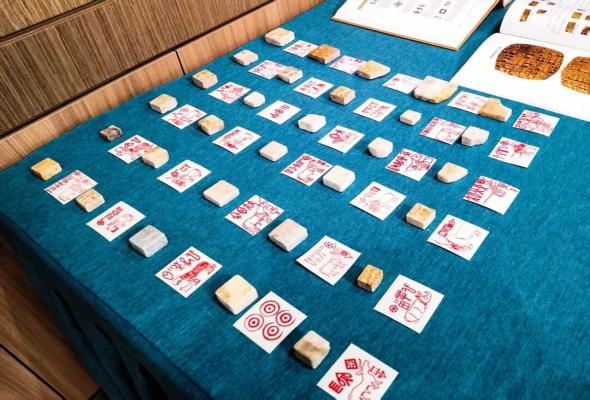
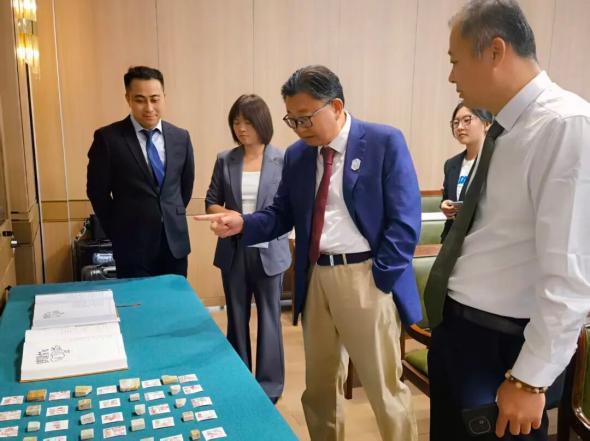
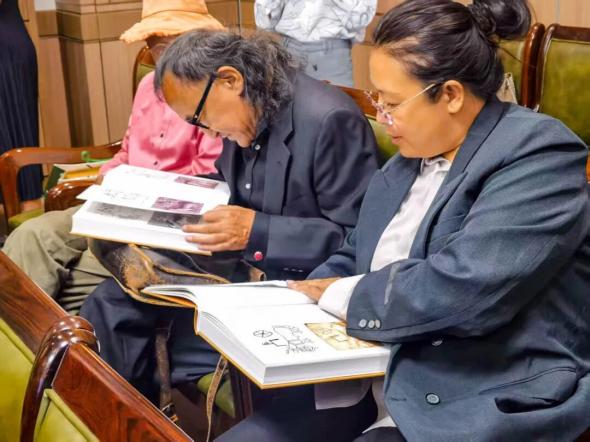
More than 30 replicas of the seals and their corresponding line drawings were displayed at the launch event. They illustrate the morphological features and combinations of the seal symbols from multiple perspectives, offering intuitive physical evidence supporting the research findings.

After the book launch, Ambassador Hashmi had a group photo taken with the book’s translation team.

编辑:李响
审核:王文秀


